
If you have invested time and money into SEO and are still not showing up when potential customers search for your services, there is a good chance the problem is not your rankings.
It is that the rules of search have fundamentally changed.
In 2026, a growing number of searches never result in a click at all. Instead, AI-powered platforms like ChatGPT, Google AI Overviews, and Perplexity read thousands of websites and deliver a single, direct answer to the user. No list of links. No scrolling. Just an answer.
If your business is not the source of that answer, you are invisible.
This is not a problem that only affects large companies or businesses in big cities. It is happening right now to small and medium businesses all across Ireland, from boutiques in Longford to web agencies in Dublin, from photographers in Cork to fitness studios in Galway.
And most of them do not know it yet.
Take Aines Boutique, a fashion retailer based in Longford with over 30 years of trading. For most of that time their business ran entirely on loyal local customers. When they launched their online store they had a decent website, great products, and a reasonable social media presence. For three years, online sales barely moved.
The problem was not the product. It was not the website. It was not even the competition.
It was that AI did not know they existed.
Once that changed, so did everything else. Aines now achieves a consistent 30% increase in online sales month on month, with 50% less spent on advertising. We will show you exactly how later in this guide.
But first, you need to understand what AEO is, why website clicks are collapsing across Ireland, and why this matters more than almost anything else in Irish digital marketing right now.
The Collapse of the Website Click
Before we explain what AEO is, it is worth understanding what is actually happening to search traffic right now, because the numbers are stark.
Customers Are Getting Answers Without Ever Visiting Your Website
According to research from SparkToro and Digital Applied, 64.82% of all Google searches in 2026 now end without a single click to any website. The user asked a question. Google answered it. Your website never saw them.
When an AI Overview is present in the search results, that zero-click rate rises to between 80 and 83%. And on AI-native platforms like ChatGPT Search, Perplexity, and Google AI Mode, the zero-click rate reaches as high as 93%.
For Irish businesses that have spent years building their Google rankings, this is a significant shift. Being on page one of Google used to almost guarantee the click. Now it often does not.
Organic Click Through Rates Are in Freefall
The data on click through rates tells the same story. Research tracking 25 million organic impressions across 42 organisations found that organic click through rates for queries with AI Overviews fell 61%, dropping from 1.76% down to 0.61%. Informational queries, the kind that most blog content targets, saw organic traffic declines of between 30 and 40% as AI Overviews handle these query types best.
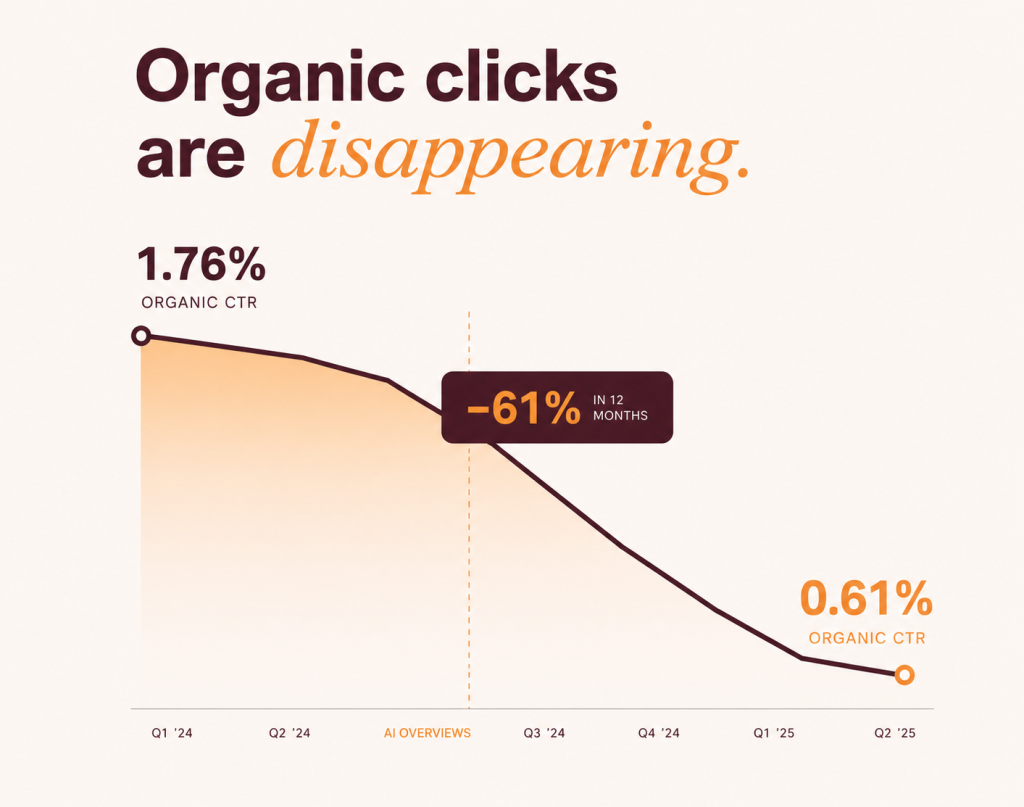
For Irish businesses, ePresence reported that a 25% drop in traditional search engine volume is predicted by Gartner as AI-powered answer engines absorb more of the queries that once drove clicks to websites. For a solicitor in Cork, a plumber in Galway, or a web agency in Dublin, these are not abstract statistics. They are enquiries that are going elsewhere.
The Silver Lining: Being Cited Changes Everything
Here is the part that most businesses miss entirely.
While clicks are declining for businesses that are not cited by AI, the opposite is true for those that are. Research from Velacore found that brands cited in AI Overviews earn 35% more organic clicks and 91% more paid clicks compared to non-cited competitors on the same queries.
And Adobe Digital Insights found that AI-referred traffic converts 31% better than traditional organic traffic. The visitors who arrive from AI citations are higher intent, better informed, and more ready to buy.
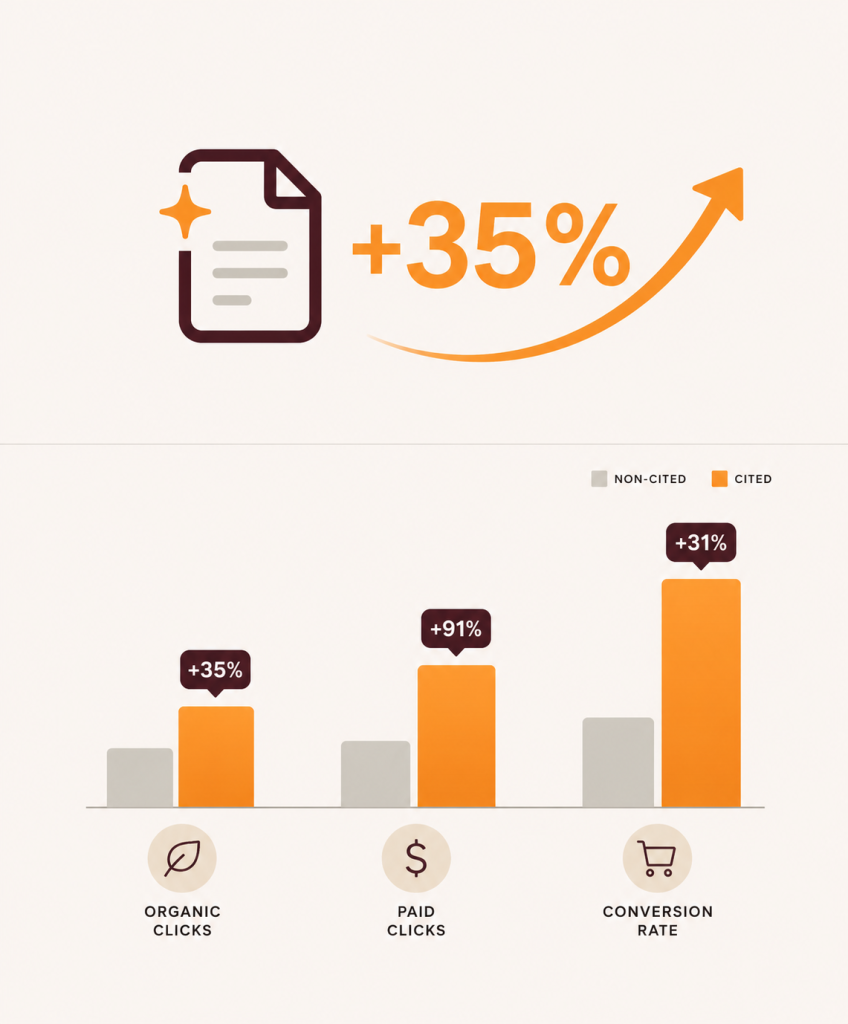
The conclusion is clear. The question is no longer whether to optimise for AI. It is how quickly you can do it before your competitors do.
What Is AEO?
AEO stands for Answer Engine Optimisation. It is the practice of structuring your content so that AI-powered search platforms can easily understand, trust, and cite it as a direct answer to a user’s question.
Traditional SEO focuses on getting your website to rank on page one of Google. AEO goes a step further. It focuses on making your content the actual answer that AI engines deliver to users, whether through featured snippets, voice assistant responses, or AI chat results.
In simple terms: SEO gets you ranked. AEO gets you cited.
Why This Distinction Matters for Irish Businesses
According to Gartner, traditional search volume is predicted to drop by 25% as AI chatbots and virtual assistants absorb more of the queries that once drove clicks to websites. Meanwhile, ChatGPT alone now handles over 2 billion queries daily, and AI-referred sessions to websites grew 527% year on year through mid-2025.
For Irish businesses, this is not a trend to watch from a distance. It is happening right now, and it is changing how your potential customers find you.
How Is AEO Different From SEO?
SEO and AEO are closely related but they serve different goals.
What SEO Does
SEO is about visibility in traditional search results. You target keywords, build links, and optimise your pages so Google ranks them highly. When someone searches, they see a list of results and click through to your website.
What AEO Does
AEO is about being the source AI uses when it generates an answer. Instead of ranking in a list, your content gets extracted, quoted, or cited directly inside the AI response. The user may never see a list of results at all.
The key differences are:
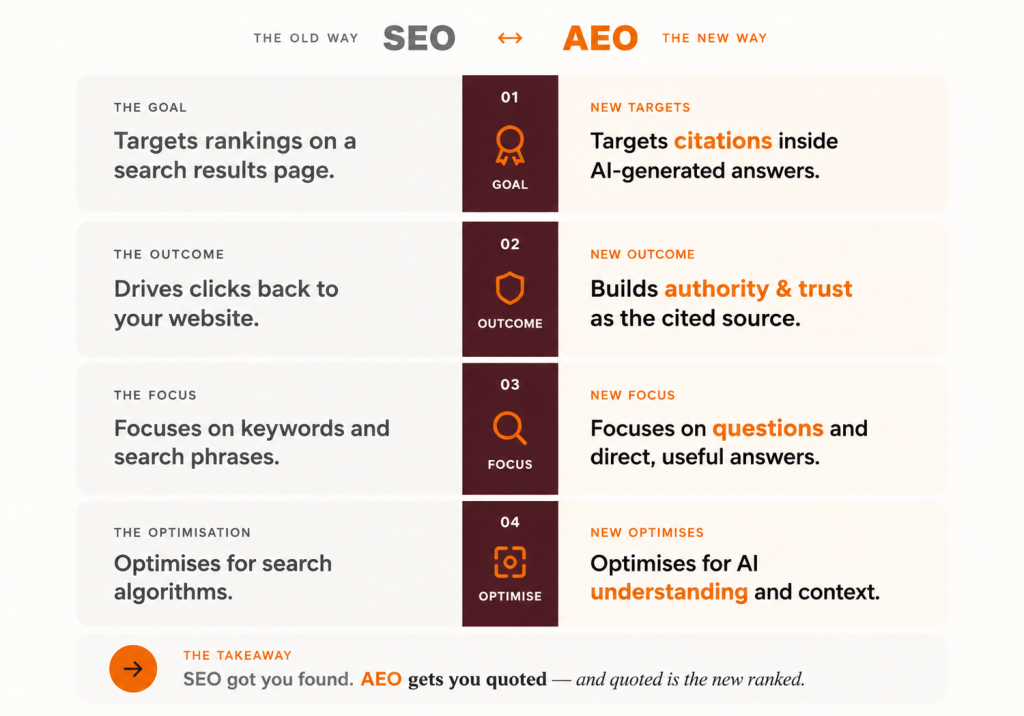
- SEO targets rankings. AEO targets citations.
- SEO drives clicks. AEO builds authority and trust.
- SEO focuses on keywords. AEO focuses on questions and direct answers.
- SEO optimises for algorithms. AEO optimises for AI understanding.
Do You Need Both?
Yes. The good news is that SEO and AEO are not in competition. Done well, they support each other. Content that answers questions clearly tends to rank well in traditional search and perform well in AI search at the same time. The strongest digital strategies in 2026 combine both.
Why Irish Businesses Need AEO Right Now
Ireland’s digital landscape is changing fast. For local service businesses, the stakes are particularly high.
Think about how your customers search today. Someone looking for a web designer in Dublin, a photographer in Cork, or a social media manager in Galway is increasingly likely to ask an AI assistant rather than type into Google. If the AI does not know your business exists, or cannot find a clear, trustworthy answer from your website, a competitor gets the enquiry instead.
There are three specific reasons why AEO is critical for Irish businesses right now.
1. Local Search Is Shifting to AI
Research shows that almost 40% of younger users now turn to platforms like TikTok or Instagram instead of Google Search for local discovery. That number is growing rapidly for AI assistants too. When someone asks ChatGPT or Perplexity to recommend a web design agency in Dublin, the platforms pull from websites they can understand and trust. Businesses with clear, well-structured content get cited. Businesses without it get ignored.
2. Irish Consumers Research Before They Buy
Irish customers research online before they call, visit, or book, especially for services and higher-value purchases. If an AI assistant answers their research questions and your business is the source, you are already building trust before the first contact is ever made. That is an enormous competitive advantage, particularly for small and medium businesses competing against larger brands.
3. Almost No Irish Businesses Are Doing This Yet
The window of opportunity for AEO in Ireland is wide open right now. According to research from Fuel Online, 62% of businesses are technically invisible to generative AI models, meaning that when AI is asked direct questions about their core services, it fails to cite them in 81% of test cases. Most Irish businesses are still focused entirely on traditional SEO. The businesses that move early will build a significant lead that will be very difficult for competitors to close.
A Real Irish Example: How Aines Boutique Used AEO to Grow Online Sales by 30%
Sometimes the best way to understand a concept is to see it working in the real world.
Aines Boutique is a fashion retailer based in Longford with over 30 years of trading. For most of that time, their business was built entirely on in-store customers, loyal Longford locals who knew and trusted them. When they eventually launched their online store, they had a decent website, the same products that were selling out on the shop floor, and a social media presence that posted regular product images from suppliers.
For three years, online sales barely moved.
The question they came to us with was simple and honest: is this just the reality for a local boutique? Can a clothing store from Longford ever compete online with boutiques from Dublin, Cork or beyond?
The answer was yes. But first, we had to understand how their customers actually search.
Understanding Search Intent: The Key That Changed Everything
The fashion boutique market has a specific challenge that makes AEO particularly powerful. Most boutiques stock the same seasonal ranges from the same suppliers and brands. So when a customer in a town without a nearby boutique goes online to shop, how do they decide who to buy from?
To answer that, you have to understand the four types of search intent and how they apply to a real customer journey.
Buying Intent: The Customer Who Already Knows What They Want
Imagine a customer who has seen a specific dress on an Instagram Reel from another boutique that has already sold out in their size. They want that exact dress. They go to Google or ChatGPT and search for it by name, by brand, or by description.
This is buying intent. They are not browsing. They are ready to purchase and they will go with the first trusted result that shows they stock it.
The question is: how do you make sure your boutique is the one AI recommends for that specific product?
There is no guaranteed way to achieve it. But there are concrete steps that work.
For Aines, we created in-depth blog posts and detailed product descriptions organised by brand and by item within each brand. This made it unambiguous to AI engines that Aines stocked those specific products. We also created social media posts and videos that mentioned specific brands by name, content that gets indexed by Google and surfaces in AI results.
The result: Aines now appears in AI recommendations for most of the brands they stock. If someone asks an AI assistant which boutiques in Ireland stock Monari, Aines comes up as one of the top five suggested results. That visibility did not exist three years ago.
Information Intent: The Customer Who Does Not Know They Need You Yet
Not every potential customer knows they are ready to buy. Some are searching because they have a problem they cannot solve.
Consider this search: “Why is my bra digging into my shoulder even though it fits everywhere else?”
That customer is not searching for a boutique. They are not searching for a product. They are searching for an answer to a very specific, frustrating problem. They do not yet know that the solution might be a different bra fitting, a different brand, or a different style entirely.
This is information intent. And it represents one of the biggest missed opportunities for most Irish businesses.
By creating educational, genuinely helpful content that answers these specific questions, Aines began showing up at the very start of the customer journey, long before the customer was ready to buy. The content answered the question, built trust, and introduced Aines as an authority on the topic.
Consideration Intent: The Customer Weighing Their Options
Once the customer understands their problem, they move into consideration. They want to know what options exist, what brands address the issue, what price points are available, and what would work best for their specific situation.
This is where content that covers different brands, different styles, and different solutions at different price points becomes essential. It helps the customer think through their decision and positions your business as the most knowledgeable, helpful voice in the conversation.
Transaction Intent: Making It Easy to Buy
Once the customer knows what they want and who they trust, the final step is making the purchase as smooth as possible. Clear product pages, easy navigation, simple checkout, and straightforward returns all reduce the friction between decision and purchase.
Together, these four stages form a complete content strategy that meets the customer wherever they are in their journey. And this approach applies to every industry, not just fashion retail. Whether you are a solicitor in Galway, a photographer in Kerry, or a web agency in Dublin, your customers go through the same journey every time they search.
The Results
Aines Boutique has achieved a consistent 30% increase in online sales month on month compared to the previous year. At the same time, they reduced their advertising spend by 50%. The product range has not changed significantly. What has changed is how they communicate with customers and how AI understands and represents their business.
AI now recognises Aines as an authority in their space. They rate in AEO results when someone searches for a boutique with an in-store stylist in Ireland, which is one of Aines’ most important unique selling points and a key differentiator from competitors who only sell online. They rank for most of the brands they stock. And they are reaching customers in towns and counties across Ireland that would never have found them through traditional local search alone.
The lesson for any Irish business is straightforward. Your product may be similar to your competitors. Your prices may be comparable. But the business that explains itself most clearly, answers the most specific questions, and makes AI understand exactly what it offers and who it serves will win the customer who is searching.
If you would like to discuss how AEO could work for your business, get in touch with us for a free consultation.
How AEO Actually Works
For AI engines to cite your content, they need to be able to do three things easily: understand what your content is about, trust that it is accurate and authoritative, and extract a clear, direct answer to use in their response.
This comes down to how your content is written and structured.
Write Answer-First Content
The most important shift in AEO is moving to an answer-first content format. This means leading every section with a direct, clear answer to the question being asked, and then following it with supporting detail.
Instead of building up to an answer across several paragraphs, start with a single sentence that directly answers the question. AI engines scan for the clearest, most direct answer they can find. If your content buries the answer, they will find it somewhere else.
Use Question-Based Headings
Structure your content around the questions your customers are actually asking. Instead of headings like “Our Services” or “About Digital Marketing”, use headings like “What is AEO?”, “How does AEO help local businesses?” or “What is the difference between SEO and AEO?”
Question-based headings signal to AI engines exactly what each section answers, making it far easier for them to match your content to the right query and cite it in their response.
Add a Detailed FAQ Section
FAQ sections are one of the most powerful tools in AEO. AI engines prioritise well-structured FAQ content because it provides clear, self-contained answers to specific questions. Every blog post and service page on your website should include a FAQ section that addresses the real questions your customers ask.
Use Structured Data and Schema Markup
Schema markup is code added to your website that helps search engines and AI platforms understand what your content means, not just what it says. FAQ schema in particular signals to AI engines that your content contains direct question-and-answer pairs.
If you are on WordPress, plugins like Rank Math make it straightforward to add FAQ schema without any coding required.
Build Topical Authority
AI engines do not just look at individual pages. They evaluate your website as a whole to assess whether you are a trustworthy, authoritative source on a topic. This means publishing consistent, in-depth content around the topics that matter most to your business.
The more comprehensively you cover your topic area, the more likely AI engines are to cite you as a reliable source when a relevant question is asked.
Keep Your Business Information Consistent
AI engines pull information about your business from multiple sources including your website, your Google Business Profile, social media, and third-party directories. If your business name, address, phone number, or service descriptions differ across these platforms, AI engines become uncertain about your business and are less likely to recommend it.
Consistency across all platforms is one of the simplest and most overlooked aspects of AEO.
What Is GEO and How Does It Relate to AEO?
You may also have heard the term GEO, which stands for Generative Engine Optimisation. The two terms are closely related but cover slightly different ground.
AEO focuses specifically on getting your content cited in direct answers generated by AI platforms. GEO is the broader discipline that covers all strategies for optimising content across generative AI platforms, including how your brand appears in AI-generated summaries, recommendations, and comparisons.
Think of AEO as a core part of GEO. Both are about ensuring your business is visible and trusted in the AI-powered search environment, not just in traditional Google results.
At Avoura, our SEO, AEO and GEO service is built around exactly this approach, combining traditional search optimisation with the strategies needed to stay visible as AI search continues to grow.
A Practical AEO Checklist for Irish Businesses
If you want to start optimising for answer engines today, here are the most important steps:
- Write answer-first content that leads every section with a direct response to the question
- Use question-based headings throughout your blog posts and service pages
- Add a detailed FAQ section to every important page on your website
- Implement FAQ schema markup using a plugin like Rank Math
- Ensure your Google Business Profile is fully completed and up to date
- Build consistent, in-depth content around your core topic areas
- Make sure your business name, address, and contact details are consistent across all platforms
- Use clear, plain language that AI engines can easily extract and understand
- Include statistics and data from credible sources to signal trustworthiness
- Link internally between related pages to demonstrate topical depth
How Long Does AEO Take to Work?
AEO is not an overnight fix. Like traditional SEO, it requires consistent effort over time. However, because so few Irish businesses are currently optimising for answer engines, the opportunity to build early authority is significant.
What to Expect in the First Six Months
Businesses that start now and publish consistent, well-structured content can expect to see meaningful improvements in AI visibility within three to six months. Those improvements compound over time as topical authority builds and more content gets indexed and cited.
Why Acting Now Matters
The businesses that will dominate Irish local search in 2026 and beyond are the ones investing in AEO today, while their competitors are still focused solely on traditional SEO. According to Fuel Online, 94% of brands are still investing heavily in traditional SEO while remaining invisible to AI. The gap between those who act now and those who wait will only widen.
Final Thoughts
Search has changed. The businesses that adapt fastest will earn a significant advantage over those that wait.
AEO is not a replacement for SEO. It is the natural evolution of it. By structuring your content to answer questions clearly, building topical authority, and making your website easy for AI engines to understand and trust, you position your business to be found not just on Google, but across the entire AI-powered search landscape.
For Irish businesses competing locally, this is one of the highest-impact investments you can make in your digital presence right now. The window of opportunity is open. Very few Irish businesses are moving on this yet. The ones that do will be the ones their customers find first.
If you would like help implementing AEO for your business, explore our SEO, AEO and GEO service or get in touch with us to discuss your goals.
You might also find our guide on why your website gets traffic but no leads useful for turning that AI-driven visibility into real enquiries.
Frequently Asked Questions
What is AEO in simple terms?
AEO stands for Answer Engine Optimisation. It is the practice of structuring your website content so that AI-powered platforms like ChatGPT, Google AI Overviews, and Perplexity can easily understand and cite it as a direct answer to a user’s question. While SEO focuses on ranking in search results, AEO focuses on becoming the source AI uses when generating answers.
Why is AEO important for Irish businesses?
AEO is important for Irish businesses because an increasing number of potential customers are using AI assistants to research services and find local providers. Research shows that 64.82% of all Google searches now end without a click to any website, and that figure rises to over 80% when AI Overviews are present. If your website is not structured to be cited by these platforms, your business will be invisible to a growing majority of searchers.
What is the difference between AEO and SEO?
SEO focuses on ranking your website pages in traditional search engine results and driving clicks. AEO focuses on making your content the direct answer that AI engines cite in their responses. SEO drives traffic through rankings. AEO builds authority through citations. Both are important and work best when combined.
What is the difference between AEO and GEO?
AEO focuses specifically on getting your content cited in AI-generated answers. GEO, or Generative Engine Optimisation, is the broader discipline covering all strategies for optimising your presence across generative AI platforms. AEO is a core component of GEO.
How do I optimise my website for AEO?
The most effective AEO strategies include writing answer-first content with direct responses at the start of each section, using question-based headings, adding FAQ sections to every important page, implementing schema markup, building consistent content around your core topic areas, and ensuring your Google Business Profile and contact details are fully up to date and consistent across all platforms.
How long does AEO take to show results?
Like traditional SEO, AEO requires consistent effort over time. Most businesses that implement AEO strategies consistently can expect to see meaningful improvements in AI search visibility within three to six months. Early movers in the Irish market have a significant advantage given how few businesses are currently optimising for answer engines.
Does AEO replace SEO?
No. AEO does not replace SEO. It works alongside it. Traditional SEO remains important for ranking in Google search results and driving website traffic. AEO extends your visibility into the AI-powered search environment. The strongest digital strategies in 2026 combine both.
Can small Irish businesses compete with larger brands through AEO?
Yes. AEO actually levels the playing field to some extent. AI engines prioritise content clarity, authority, and structure over brand size or advertising budget. A small Irish business with well-structured, authoritative content can be cited ahead of a larger competitor whose website is harder for AI to parse and understand. Aines Boutique is a perfect example of this. A 30-year-old fashion retailer from Longford now appears ahead of larger national competitors in AI search results for the brands they stock, simply because their content is clearer, more specific, and better structured.
Can AEO work for eCommerce and retail businesses in Ireland?
Absolutely. As the Aines Boutique example shows, AEO is particularly powerful for Irish retail businesses. By creating content that addresses all four stages of search intent, from information and consideration through to transaction, and by clearly communicating which specific brands and products you stock, AI engines can recommend your business to shoppers across Ireland who are searching for exactly what you sell. The key is making it impossible for AI to misunderstand what you offer and who you serve.